The US–Israeli military campaign against Iran, launched February 28, 2026, is sending shockwaves through global trade routes, energy prices, and air cargo networks — with Bangladesh’s denim and garment sector facing immediate and compounding consequences.
Conflict timeline

Key numbers at a glance
| 1,200+
Tonnes of garments stranded at Dhaka Airport |
≈$120
Brent crude per barrel (peak, early March 2026) |
20%
Global oil supply transiting the Strait of Hormuz |
6+
Airlines suspending cargo operations from Dhaka |
Sea-route reality: Chittagong to Europe
DISRUPTED / INACCESSIBLE
Via Suez CanalChittagong → Indian Ocean → Red Sea ⚠ → Suez ⛔ → Med Sea → Europe Previously open ~22 days. Now inaccessible due to Red Sea Houthi attacks AND new Iran conflict security threat extending into the Persian Gulf corridor. Suez revival hopes have collapsed.
Effectively closed since February 28, 2026 |
CURRENT ACTIVE ROUTE (FORCED)
Via Cape of Good HopeChittagong → Indian Ocean → South Africa → Atlantic → Europe Transit time now 30–35 days. Adds ≈5,000 km. Significantly higher fuel costs and port congestion. Buyers facing delayed season deliveries with contractual penalty exposure.
Operational but costly — +10–12 days, +30–40% freight cost |
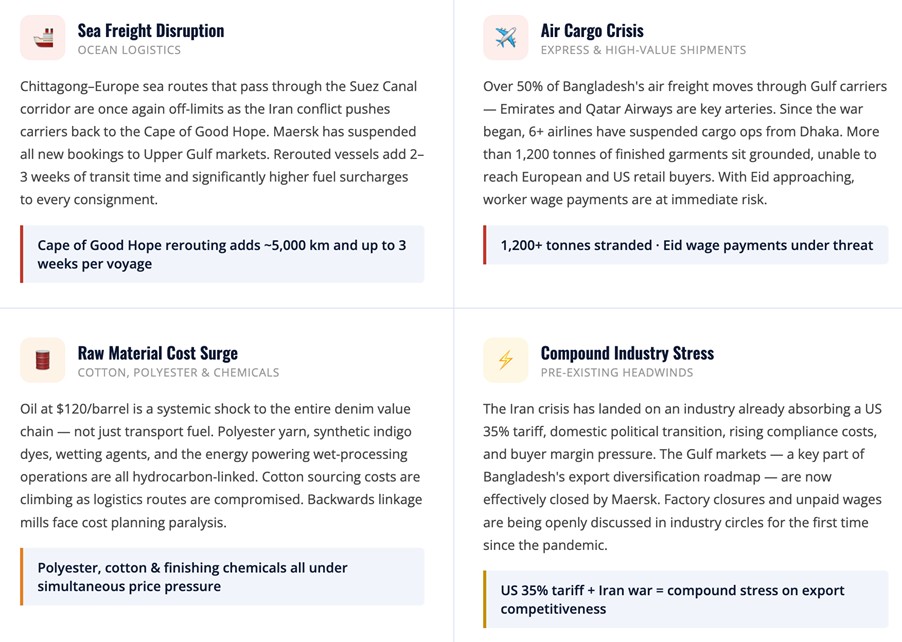
Critical Impact Areas
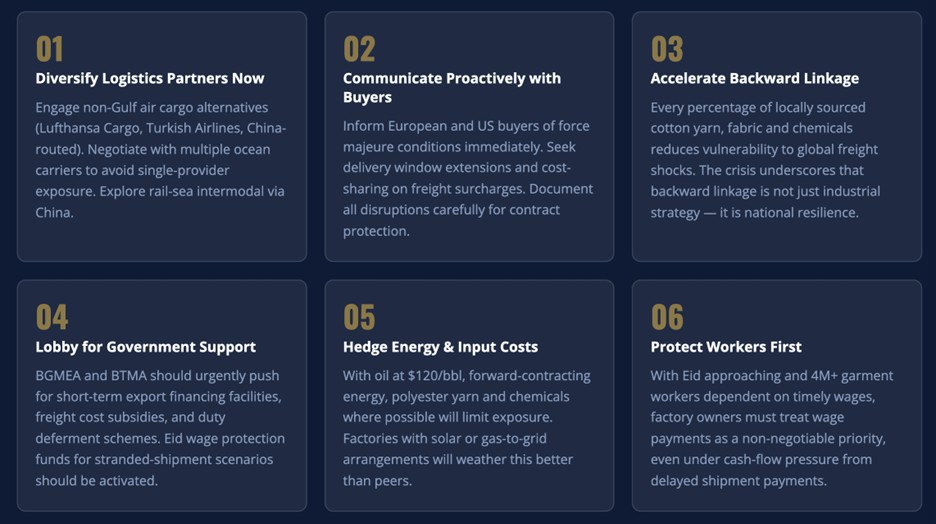
Strategic Actions for Bangladesh
Risk and Opportunities Outlook
| NEAR-TERM RISKS
● Order cancellations if shipment delays exceed contractual grace periods ● Worker wage disruptions ahead of Eid due to stranded cargo ● Freight costs eroding margins already compressed by the US 35% tariff ● Gulf export markets (UAE, Saudi Arabia, Qatar) effectively closed to new sea shipments ● Polyester and chemical costs spiraling with no short-term relief in sight |
LONGER-TERM OPPORTUNITIES
● Crisis accelerates logistics diversification, reducing over-reliance on Gulf air routes structurally ● Backward linkage investment gains new urgency and political support ● Bangladesh’s proven resilience strengthens long-term buyer trust vs. less stable sourcing alternatives ● Shared crisis creates opportunity for BGMEA to push for meaningful government freight support policy ● Factories with renewable energy and local sourcing emerge as more competitive post-crisis |
The Iran conflict is not landing on a sector at ease. It is landing on an industry already stretched, already adapting, already absorbing shocks from multiple directions simultaneously. Bangladesh denim must face this with clear eyes, strategic composure, and a collective determination to protect what decades of hard work have built.