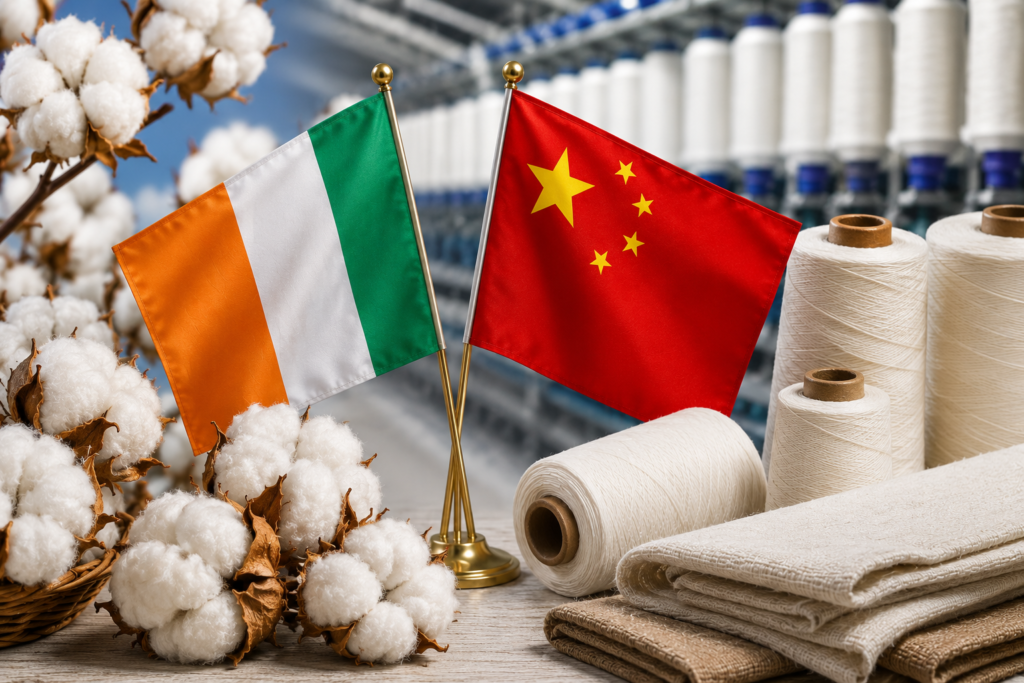
A new agreement between CCA-K and CCPIT-TEX aims to attract Chinese investment, technology and industrial expertise as Côte d’Ivoire seeks to process more of its cotton domestically. Côte d’Ivoire has signed a strategic textile cooperation agreement with China to accelerate local cotton processing and develop a more integrated textile and apparel industry.
The agreement was signed on 25 August 2026 between Côte d’Ivoire’s Cotton, Cashew and Shea Council (CCA-K) and the textile industry sub-council of the China Council for the Promotion of International Trade, commonly known as CCPIT-TEX. The signing took place in Shanghai during Intertextile Shanghai Apparel Fabrics – Autumn Edition, held from 25–27 August 2026 at the National Exhibition and Convention Center. According to CCA-K, the partnership is intended to facilitate cooperation between Ivorian operators and Chinese investors across the textile and apparel value chain.
Partnership Targets Investment and Technology Transfer
Côte d’Ivoire is seeking more than foreign capital. The country also wants access to technologies, industrial equipment, technical expertise and workforce training that could strengthen the weaker stages of its textile value chain. China represents a strategically important partner for this objective because of its extensive capabilities in spinning, weaving, knitting, dyeing, finishing, garment manufacturing and textile machinery production.
Chinese companies could potentially support the development of new industrial facilities while transferring production knowledge required to operate them efficiently. The agreement does not yet represent a confirmed investment in a specific factory. Instead, it establishes a framework intended to encourage future commercial partnerships, technology cooperation, training and investment projects between companies in the two countries. Its industrial impact will therefore depend on whether these discussions result in operational spinning, weaving, finishing and garment manufacturing facilities.
More Than 90% of Cotton Exported Unprocessed
Côte d’Ivoire is an important West African cotton producer, but most of the value generated after ginning currently leaves the country. According to information published by the Investment Promotion Center of Côte d’Ivoire (CEPICI), more than 90% of the country’s cotton is exported in raw form, primarily to Asian markets. This means Côte d’Ivoire earns revenue from cotton production and ginning but captures only a limited share of the value created through spinning fibre into yarn, manufacturing fabric and converting textiles into finished apparel and home textile products.
Expanding domestic processing could generate more industrial employment, improve export earnings and reduce the economy’s reliance on shipments of unprocessed agricultural commodities. It could also strengthen connections between cotton-producing regions and the country’s wider industrial economy.
Previous Processing Target Remains Unverified
The Ivorian government previously set a target of increasing the share of locally processed cotton fiber from 11.49% in 2020 to 40% by 2025. However, no recent official assessment has confirmed whether this objective was achieved. The continued export of more than 90% of the country’s cotton in raw form suggests that substantial additional investment is still required. Available industry information indicates that Côte d’Ivoire’s spinning and weaving facilities have a combined installed capacity of approximately 26,000 tonnes per year.
Two companies involved in textile finishing reportedly possess a combined annual capacity of around 35 million meters of fabric. These facilities provide an industrial foundation, but their scale remains limited compared with the volume of cotton available and the capacity required to establish a fully integrated export-oriented textile sector.
From Cotton Producer to Textile Manufacturer
The cooperation with CCPIT-TEX reflects a broader industrial ambition: shifting Côte d’Ivoire’s position from predominantly supplying cotton fiber to manufacturing higher-value textile products.
A more complete domestic value chain could include:
- Cotton ginning and preparation
- Yarn spinning
- Weaving and knitting
- Dyeing, printing and finishing
- Garment and home textile manufacturing
- Textile waste recovery and recycling
Each additional production stage retained within the country could create technical and industrial jobs while increasing the value generated from locally grown cotton. Chinese textile companies could contribute machinery, production technology and experience in managing integrated manufacturing operations. Côte d’Ivoire, meanwhile, offers access to locally produced cotton, a growing regional market and potential opportunities within African and international trade frameworks.
Implementation Will Determine the Outcome
The agreement represents an important step in strengthening textile cooperation between Côte d’Ivoire and China, but the principal challenge will be translating the partnership into concrete industrial capacity. Large-scale textile processing requires reliable electricity, water, logistics, wastewater treatment, skilled labor and access to competitive financing. Investors will also need confidence in the consistency of cotton supply and the availability of export markets for yarn, fabrics and finished products.
If the partnership delivers new factories, technology transfer and workforce development, it could help Côte d’Ivoire retain more value from its cotton sector and emerge as a stronger textile manufacturing center in West Africa. For now, the agreement provides a platform for cooperation. Its success will ultimately be measured by how much additional Ivorian cotton is transformed into yarn, fabric and finished products inside the country.