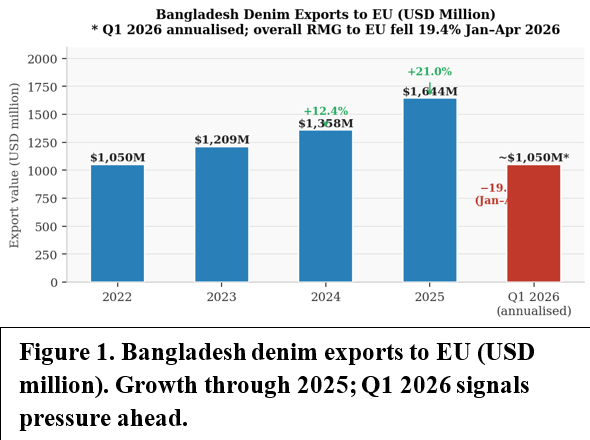
Nearly one in every three denim garments sold in Europe is made in Bangladesh, as per Eurostat trade data. Bangladesh holds a 29.88 percent share of EU denim imports; a position it built steadily after overtaking China in 2017 and has held since. EU-bound denim exports grew from $1.21 billion in 2023 to $1.36 billion in 2024, then jumped to $1.64 billion in 2025 — a 21 percent single-year increase. By any measure, Bangladesh’s European denim story is a genuine industrial achievement.
The question this editorial wants to ask is not whether the achievement is real. It is whether it is being used to build something durable or simply being harvested while conditions allow. Because the conditions are changing, and the pace of change is faster than the industry’s public positioning suggests.
The Clock That Is Already Running
Bangladesh’s EU denim dominance rests on Everything But Arms preferences — duty-free, quota-free access granted to least developed countries. EBA does not expire in 2029. It begins to expire in 2029. Bangladesh officially graduates from LDC status in November 2026, triggering a three-year transition period after which EBA preferences lapse and standard GSP rates of approximately 9.6 percent apply to most garment categories. The WTO has estimated Bangladesh could lose up to $8 billion in annual export earnings, roughly 14 percent of total export income, once the preference structure changes. Denim, as one of Bangladesh’s highest-volume EU export categories, sits directly in the exposure zone.
The industry response has generally been to point to the three-year grace period and to note that GSP+, a more generous EU preference scheme with reduced tariff rates may be available to Bangladesh if it ratifies and implements 27 international conventions on governance, labour rights, and environmental standards. That is a credible pathway. But GSP+ applications require sustained political commitment, domestic legal reform, and credible implementation monitoring. Bangladesh has not yet submitted a formal application. Three years is not as long as it sounds when the administrative, legislative, and diplomatic workload is this substantial.
Vietnam Has Already Arrived
While Bangladesh is managing a grace period, Vietnam is operating under zero tariffs today. The EU-Vietnam Free Trade Agreement, which came into force in 2020, phased apparel duties to zero by January 2026 for products meeting yarn-forward rules of origin. Vietnam built the upstream supply chain — spinning, weaving, dyeing, finishing — specifically to qualify. The result is that Vietnamese denim and garments now enter the EU entirely duty-free, permanently, with no expiry date attached.
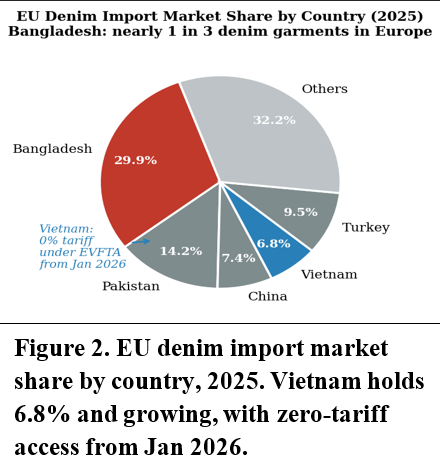
Vietnam’s current EU denim share — approximately 6.8 percent — is still well below Bangladesh’s 29.88 percent. But the trajectory matters more than the current number. Vietnam’s textile and garment exports are projected to reach $48 billion by the end of 2026, growing at nearly 10 percent year on year, while Bangladesh’s overall RMG exports to the EU fell 19.4 percent in the first four months of 2026. Bangladesh is not losing to Vietnam in EU denim today. The question is what happens in 2029 when Bangladesh faces a 9.6 percent tariff and Vietnam faces zero.
A buyer sitting in Hamburg or Amsterdam, managing a sourcing decision for 2029 and beyond, is already doing this arithmetic. Order consolidation decisions made in 2026 and 2027 will determine factory relationships in 2029. The grace period is not a pause. For buyers, it is a planning window. Bangladesh’s denim sector should be treating it the same way.
Investment Is Real but Narrowly Placed
It would be unfair to suggest Bangladesh’s denim industry has been idle. Entrepreneurs have invested approximately Tk 25,000 crore, roughly $2.3 billion, in 42 modern denim mills with a combined capacity exceeding 900 million meters of fabric annually. Leading mills have integrated spinning, weaving, washing, and finishing under one roof. LEED-certified plants, laser finishing, water recycling systems — the top tier of Bangladesh’s denim sector is genuinely world-class.
But the investment has been concentrated at the fabric and garment assembly level. Bangladesh still imports the majority of its raw cotton and a significant portion of yarn. It does not have the fibre-to-finished-garment integration that allows Vietnam to meet yarn-forward rules of origin for EVFTA qualification. If Bangladesh were to pursue an equivalent FTA with the EU — which would require far deeper diplomatic engagement than currently exists — its supply chain would need restructuring that goes beyond what the current investment wave has delivered.
The Lead Deserves to Become a Foundation
Bangladesh’s 30 percent EU denim market share is an extraordinary platform. No other country outside China has built this kind of concentration in a single product category in a single major market. The tragedy would be to spend the 2026 to 2029 window celebrating it rather than using it as leverage — to accelerate the GSP+ application, to negotiate an EU Economic Partnership Agreement that addresses the post-EBA gap, to deepen supply chain integration so the competitive case for Bangladesh denim does not rest entirely on preferential access.
Vietnam did not get to zero EU tariffs by accident. It made a political decision, invested in supply chain compliance, and executed over a decade. Bangladesh’s denim sector has the volume, the factories, and the buyer relationships to mount a comparable effort. But comparable effort requires comparable urgency. The expiry date on Bangladesh’s EU denim lead is printed clearly on the EBA schedule. The question is not whether the industry can read it. It is whether it is choosing to act on what it says.